R01 · PUMP
Vacuum pump
Leybold D25B rotary-vane, chamber evacuation

Most freeze-dryer controllers watch a setpoint. S3Pulse watches the product: three dipped thermocouples inside the peptidic liquid itself, two vacuum gauges, a heat-transfer-fluid loop — and sixteen relay channels it commands through a three-phase machine, from ULT freeze to primary sublimation to secondary desorption. This page is written from the actual control code and its engineering docs, not from a brochure.
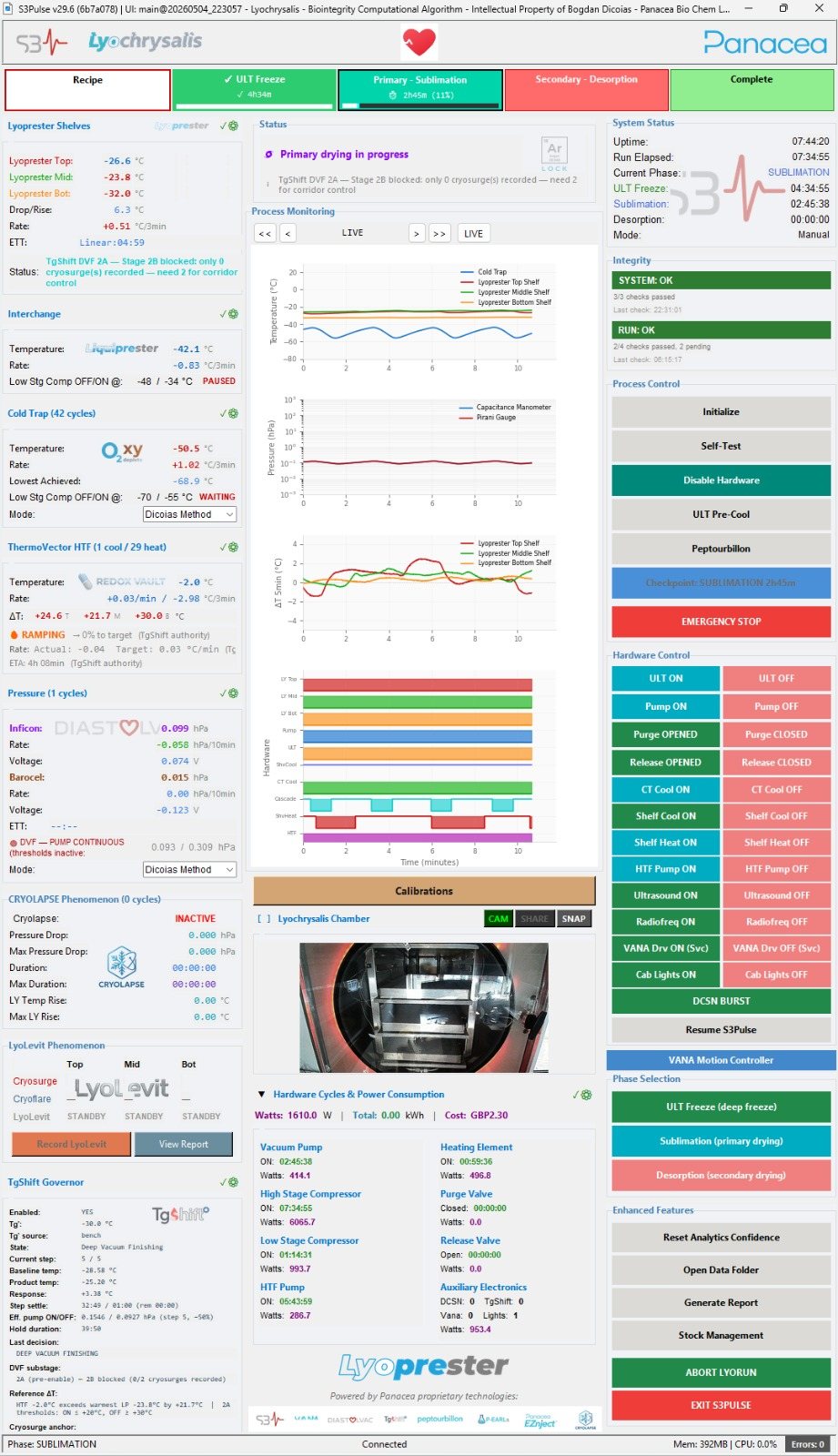
S3Pulse is the control brain of Lyochrysalis, Panacea Bio Chem's research freeze-dryer — and the shell that links the wider automation family, from the PleniDose Gantry's filling modes to the Peptourbillon formulation calculator. It is biomimetic in method: its control loops imitate how a skilled freeze-drying scientist reads a run — watching the product's own thermal behaviour for the events that matter (nucleation, sublimation onset, dryness), then acting on hardware through named, interlocked channels. Every claim on this site traces to the S3Pulse codebase, its hardware inventory, or operator-authored doctrine.
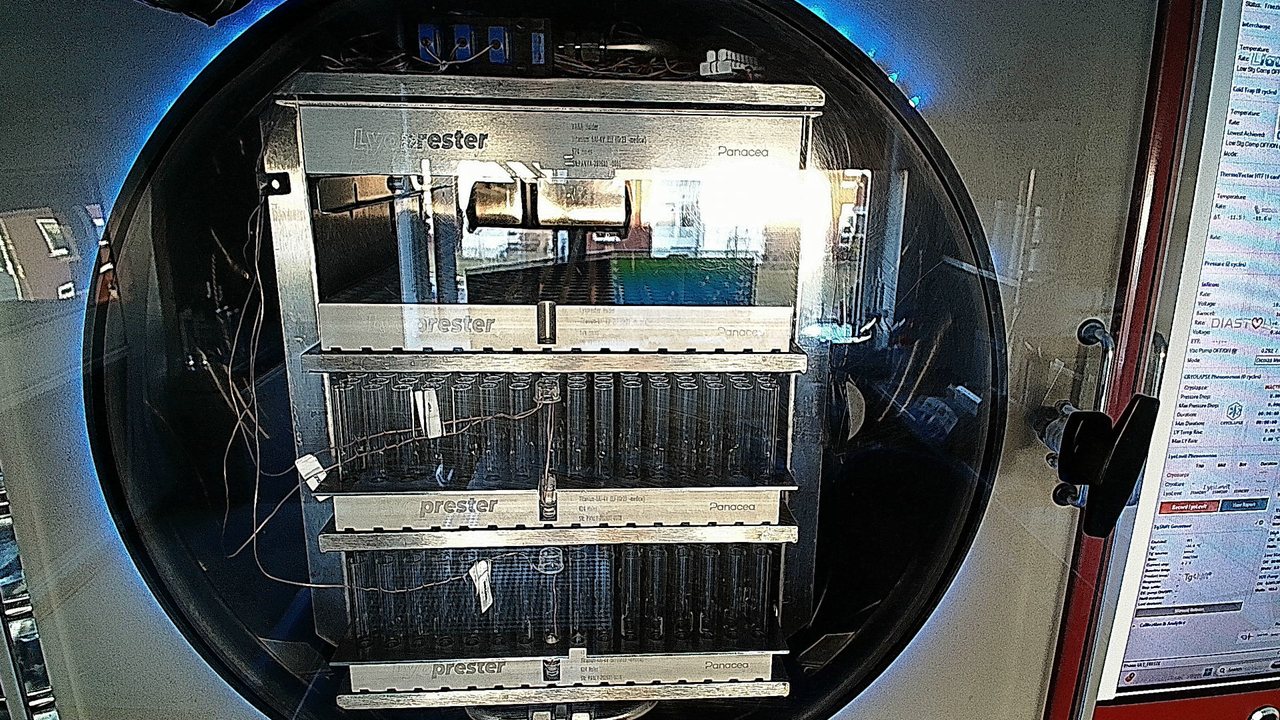
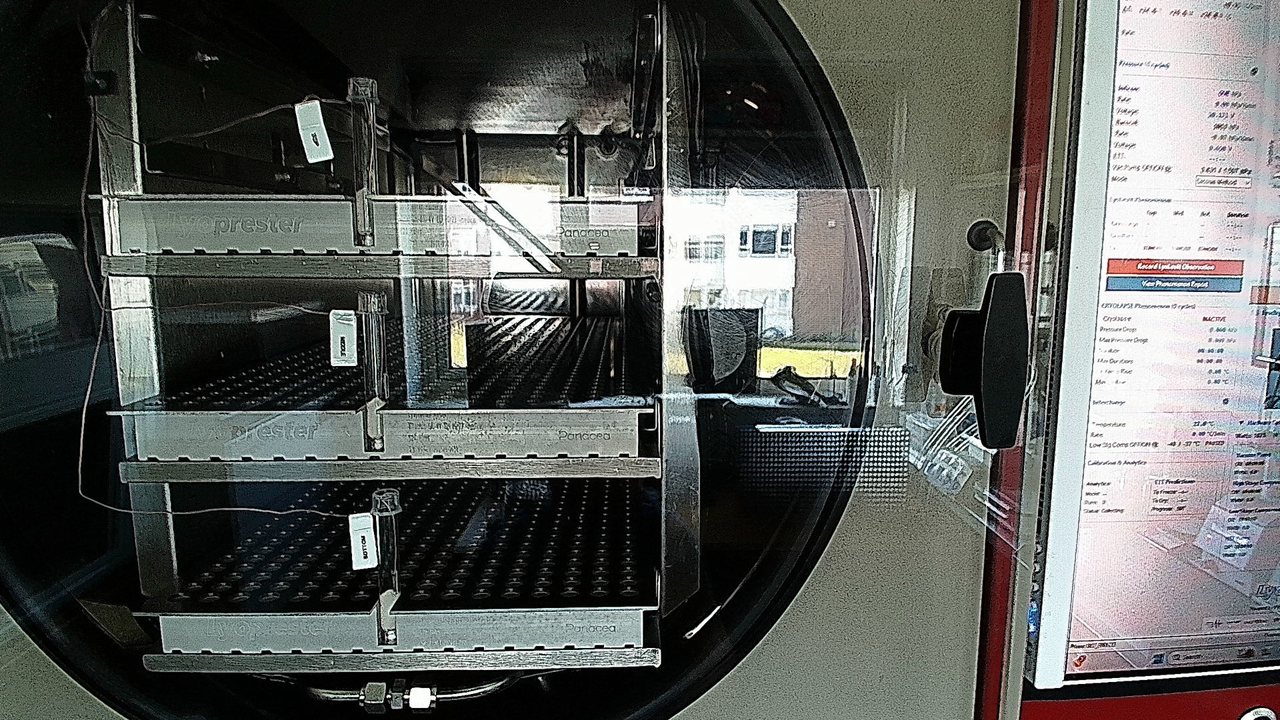
The product temperature authority is not chamber air and not a shelf setpoint: it is the warmest of three dipped Lyoprester probes (top / mid / bottom), read over an ADAM-4019 thermocouple module. Nucleation triggers, rebound confirmation and governor decisions all key off real product.
A Waveshare Modbus-TCP relay board carries all sixteen channels; the release valve is operator-only with explicit confirmation — the software never vents the chamber on its own. Pressure paths fail visibly: an unanswered relay aborts the sequence instead of pretending.
Sensor dropouts freeze displays at their last truth and mark it; pressure peaks above gauge range are labelled UNMEASURED, never estimated into a chart; the computational-intelligence stack is advisory by construction and cannot touch a recipe without the operator's explicit apply.
A cascade-compression ULT freezer, a Leybold D25B rotary-vane pump (~0.015 hPa ultimate), a cold trap, shelves served by the ThermoVector heat-transfer-fluid loop, and a gauge pair — an Inficon capacitance manometer and a Barocel chamber gauge — wrapped around a chamber that holds Lyoprester cartridges. S3Pulse names every channel it can move:
One cycle, three hardware-driven phases — transitions are sensor-gated, not timer-blind:
Instead of bang-bang heating, S3Pulse learns the heat-transfer coefficient (Kv) of the actual machine with the actual load, predicts shelf warming from HTF temperature, accounts for a thermal lag of two-plus minutes, and interpolates Kv against chamber pressure — gas conduction at 1 Pa is roughly 30% of the 50 Pa reference, at 1000 Pa roughly 130%. Calibration happens during a live run: a few minutes of real heating data yields Kv, per-shelf factors and a data-quality score, saved for every later cycle. The ramp runs continuously from sublimation through desorption — one trajectory, no restart.
S3Pulse is the brain; around it orbits a constellation of Panacea technologies — process physics, protective systems, container architectures and computational intelligence. Each gets its own honest paragraph on the Technologies page.
 LyoLevitzero-contact orbital sublimation
 TgShiftRF-assisted thermal window control
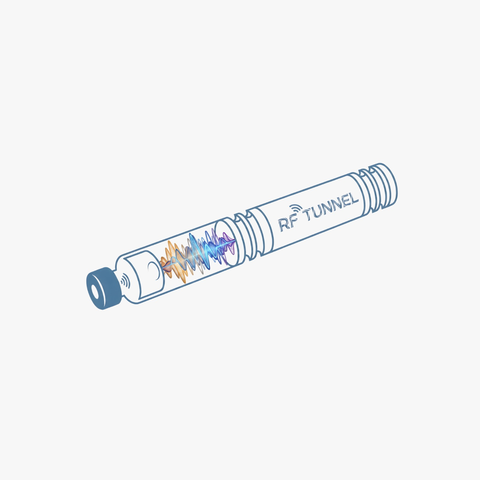 RF Tunnelcentral reconstitution path
 Cryolapsepressure-collapse dryness analytics
 DiastolVACbiomimetic vacuum orchestration
 OxyDepleteoxygen-depletion protection
 ArgonLockargon final backfill
 RedoxVaultmicrosphere redox shielding
 VANAcartridge handling logic
 EZnjectno-air-ingress autoinjection
 Peptourbillonthe formulation calculator
 Dicoias Ψadvisory computational intelligence
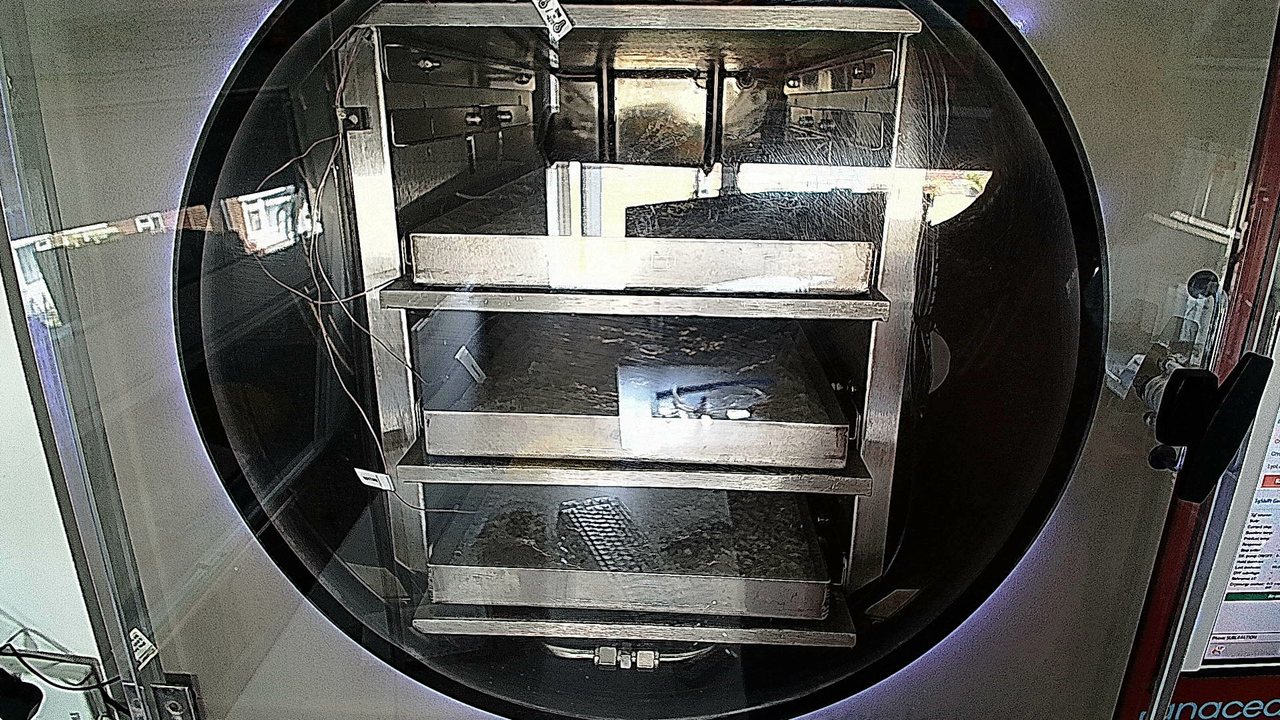
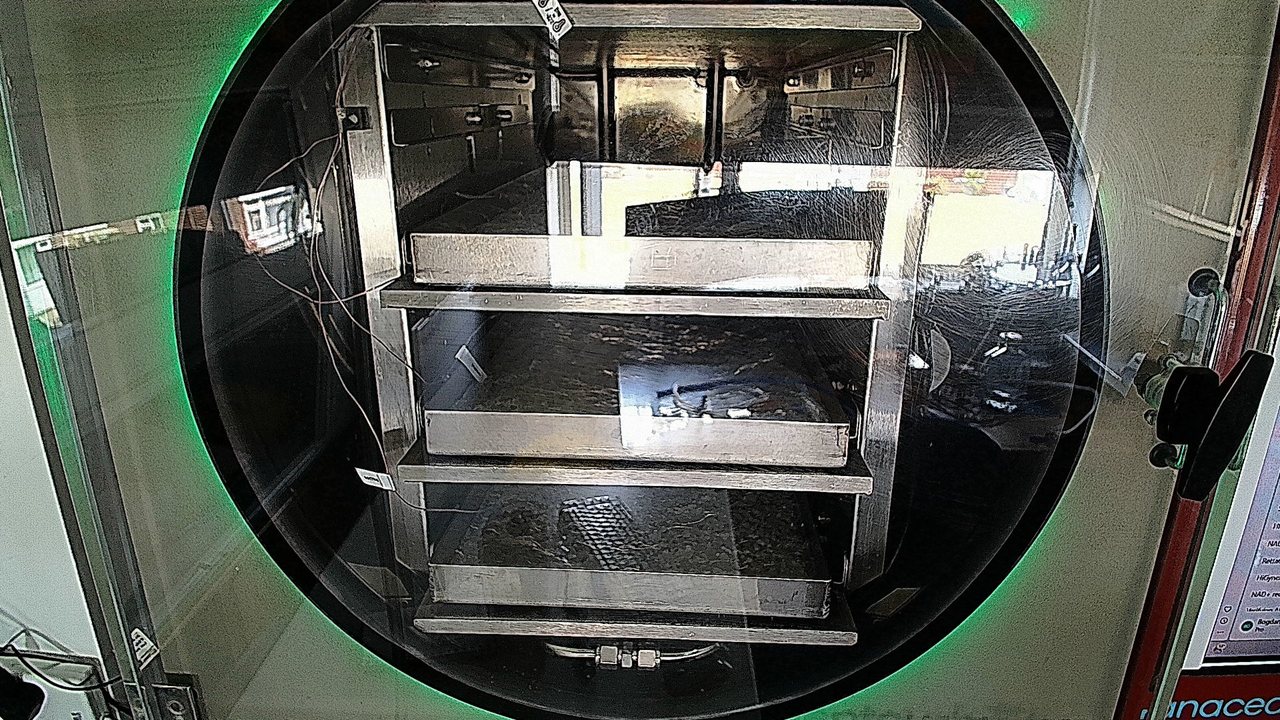
These are event-triggered chamber-camera captures from actual Lyochrysalis runs — the same frames S3Pulse stores when its detectors fire. No renders, no stock.

S3Pulse, Lyochrysalis and the constellation around them are the work of Bogdan Dicoias at Panacea Bio Chem. The doctrine is consistent across the codebase: authority lives in measured product truth, proprietary mechanisms are named and interlocked, and anything the software cannot measure it says so — in the UI, in the run report, and on this page. The full formula engine lives in Peptourbillon; the filling automation in the PleniDose Gantry; and the motion-control architecture born on that gantry in KineticON™, which carries the same doctrine down to every axis move.

"I did not want to optimize yesterday's method. I wanted to remove the bottleneck entirely."
Bogdan Dicoias — Biochemist · AAC Designer · Panacea Bio Chem Ltd — from the Cryo-Triad & LyoLevit technical briefing (February 2026)
Panacea Bio Chem's biomimetic computational algorithm — the control brain of the Lyochrysalis research freeze-dryer. It reads the machine's sensors, commands sixteen relay channels through a three-phase cycle, and hosts the Peptourbillon calculator and the Dicoias Ψ advisory stack.
Three thermal events named by Bogdan Dicoias: Cryosurge (nucleation exotherm), Cryoflare (sublimation-onset endotherm) and Cryolapse (pressure-driven vapour redistribution). S3Pulse detects and logs all three during real runs.
No. The intelligence stack is display-only and advisory by construction — it never enters the engine, the recipe or the actuators. Recipe governance changes require the operator's explicit apply.
Zero-contact orbital sublimation: the cake lifts on its own vapour and spins through primary drying, turning every surface into a sublimation surface. More on the Technologies page and the Questions page.
Freeze-drying process-control software is the layer between a freeze-dryer's hardware and its product: it commands shelf temperature, chamber pressure and valves, and it decides when one phase ends and the next begins. S3Pulse is one implementation of that category — this section defines the category itself, from the published record. The discipline's own name for measurement-driven process control is process analytical technology (PAT), surveyed for freeze-drying by Fissore, Pisano & Barresi (2018).
A lyophilization recipe (cycle) is the program the dryer executes: shelf-temperature ramps and holds, chamber-pressure setpoints, and the rules for moving from freezing to primary drying (sublimation of ice) to secondary drying (desorption of bound water). Developing one means finding the conditions a specific formulation tolerates — the published design-space tradition frames this around the product's critical temperature (Tang, Nail & Pikal, 2005).
An open-loop (fixed) recipe follows the clock: setpoints change at pre-set times whatever the product is doing. A closed-loop (adaptive) cycle responds to measurements — product temperature, pressure-rise tests — as they happen. Regulatory authors document both tracks in current human-drug applications and inspections (Rhieu et al., 2025).
The foundational automated cycle-development work used manometric temperature measurement (MTM): brief pressure-rise interruptions that estimate product temperature mid-run and feed a control algorithm (Gieseler, Kramer & Pikal, 2007). A single-machine trial with equipment caveats the paper states itself — the category's starting point, caveats included.
Six product classes answer the same "freeze-drying software" queries, and search results rarely separate them. This is the map as the classes actually differ — competitors and free tools linked by name, because a map that hides rivals is marketing, not documentation.
Record, archive and document cycles for audit trails. They observe the run; they do not steer it. Example: Ellab ValSuite (vendor description).
Production-line controllers that run a fixed recipe faithfully: setpoint in, setpoint held, alarms on deviation. The timer-driven end of the spectrum — most installed freeze-dryer control lives here.
Simulate a cycle before running it; the output is a proposed recipe, not control. LyoPRONTO is open source with published accuracy figures (Shivkumar et al., 2019); SP Scientific's LyoModelling is the vendor counterpart (vendor description).
Adjusts the running cycle from live measurements: the SP Scientific SMART/MTM lineage (Gieseler et al., 2007), Millrock's LyoPAT/AutoDry tooling (vendor descriptions) — and S3Pulse, the sensor-gated implementation this page documents.
Model-based soft sensors and scenario optimization run alongside the process. Published studies report large scenario gains; those are model results for specific equipment, not category-wide outcomes (Klepzig et al., 2020).
Custom-cycle settings on home units (Harvest Right app documentation) and aftermarket vacuum controllers (DigiVac FYRA) — a different league, included because the queries overlap.
Sources for both sections. Vendor names link to vendor pages and are vendor descriptions; everything else is the peer-reviewed record:
Recent developments in the field — refreshed 2026-10-16 by Panacea Bio Chem.
The Panacea Technology Universe
Proprietary Panacea Bio Chem Ltd technologies, invented by Bogdan Dicoias — what each one does, and why it leads its class.

 Lyoprester®The only dual-chamber cartridge that is autoreconstitution-enabled, vacuum-sealed and argon-fillback.lyoprester.com ↗
 P-EARLs™Panacea-Engineered Aseptic Reconstitution Liquid(s) — each tuned to the peptide it wakes.p-earls.com ↗
 Peptourbillon™The layered peptide formulation architecture — single- or multi-layer, never a blend.peptourbillon.com ↗
 RF Tunnel™The RF-formed central channel through the cake.rftunnel.com ↗
 TgShift™Raises the cake’s glass-transition temperature with RF — instead of chilling below it.tgshift.com ↗
 Cryolapse™Cryogenic pressure collapse under S3Pulse™ control — vapour redistributed through the whole cake, not its surface, impeding crust formation.cryolapse.com ↗
 LyoLevit™The cake levitates and spins in high orbit — driven by ultrasound and RF.lyolevit.com ↗
 Lyochrysalis™The integrated chamber housing the whole drying stack.lyochrysalis.com ↗
 S3Pulse™The control brain for every piece of Panacea hardware.s3pulse.com ↗
 Liquiprester™The single-liquid cartridge engineered so multiple peptide APIs coexist in one shared vehicle.liquiprester.com ↗
 Syntheseract™Continuous-flow peptide synthesis in a special, very fast and economical way.syntheseract.com ↗
 CFSPPS™Continuous-flow solid-phase peptide synthesis, written as its own category.cfspps.com ↗
 OxyDeplete™Degassing plus no-headspace doctrine — the oxygen-starved seal.oxydeplete.com ↗
 ArgonLock™The final inert-atmosphere lock under argon.argonlock.com ↗
 RedoxVault™Separation, not merely suppression — redox isolation in lipid micro-reservoirs.redoxvault.com ↗
 PleniDose™The shared filling gantry — one machine filling both the dual-chamber Lyoprester and the liquid Liquiprester.plenidose.com ↗
 IncreSure™The dose-metrology layer — verified API per pen increment.incresure.com ↗
 ElimiVoid™Front-void elimination without touching the metered dose.elimivoid.com ↗
 Cryoviscous™The characterised cold, high-viscosity, low-mobility conditioning state.cryoviscous.com ↗
 Vana Machine™Vacuum–Argon–Nitrogen Architecture — draws the air and nitrogen out of the cake and backfills with argon; in a separate process, the same machine makes the P-EARLs bubble-free.www.vanamachine.com ↗
 EZnject™The disposable auto-injector pen built around the Lyoprester.panaceaeznject.com ↗
 Dicoias ΨThe computed-chemistry advisory — every substance reduced to a vector across physical, electronic and formulation space.dcppsi.com ↗
 SealoPrester™Aseptic Cartridge Closure System — Seal o’ Precision + Sterility.sealoprester.com ↗
 Peptidic LiquidThe peptide formulation in solution — the active plus its buffers, cryoprotectants, lyoprotectants and scaffolders.peptidicliquid.com ↗
 DiastolVAC™Biomimetic diastolic vacuum control — the pneumatic circulatory system of the machine: pumps, valves and sensors as one ensemble.diastolvac.com ↗
 KineticON™Motion Integrity Architecture — the motion-control layer that lets the machine know what happened on every axis move.kineticon.org ↗
Publications indexed in PubMed in the last 30 days for process analytical technology lyophilization OR real-time monitoring freeze-drying — refreshed weekly.